Roast Dinner, Rebalanced: Three Changes That Don't Cost You the Gravy
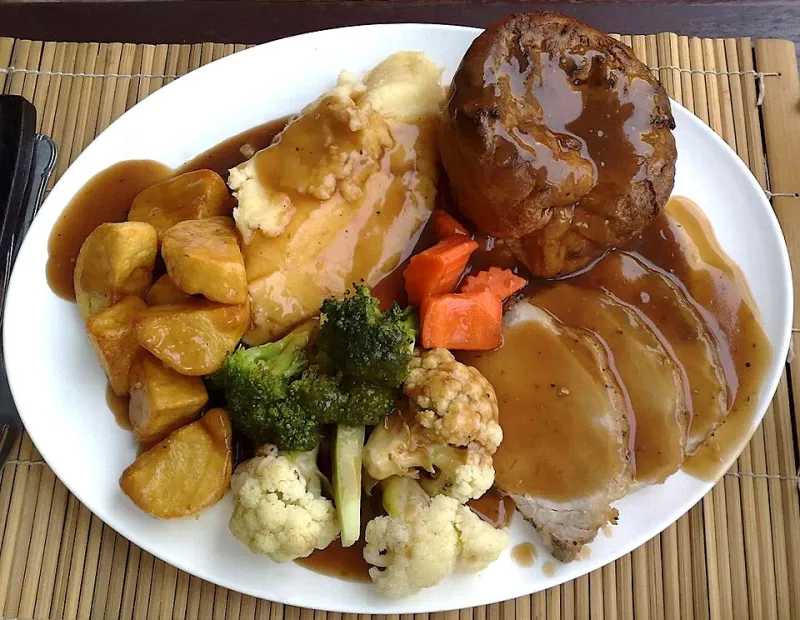
Photo: Jeff McNeill, CC BY-SA 2.0, via Wikimedia Commons
Every few months someone announces that the Sunday roast is 'back' or, conversely, that it's killing us. Neither is quite true. What's true is that a roast is mostly meat, vegetables and potatoes served with a jug of something hot, and that most of the problems people have with it come down to proportion rather than the meal itself. You don't need to swap the spuds for cauliflower rice. You just need to look at the plate for thirty seconds before you sit down.
Here's the practical version. Three tweaks, all of which a normal UK kitchen can manage without a spreadsheet.
Start with the plate, not the potato
The single most useful thing you can do is decide the veg before you decide anything else. Roughly half the plate, ideally. Not a token two carrots — a proper pile. Cabbage, leeks, carrots, swede, broccoli, greens, whatever's decent in the shop that week. In November that's likely to mean roots and brassicas, which are cheap, filling and hold up well against gravy.
Then protein — a sensible slice of meat, not a slab the size of a paperback — and then potatoes and Yorkshire in the remaining quarter.
The point isn't to police anyone. It's that vegetables bring volume and fibre that potatoes simply don't, and volume is what makes a plate feel like a meal rather than a snack you eat with a fork. If you eat the veg first because it's actually nice, you tend to eat less of the rest without noticing or feeling hard done by.
Gravy is not the villain here
Gravy is how you get a plate of plain boiled cabbage to taste like something you'd choose. That's a feature, not a bug. The issue is what's in the jug and how much of it lands on the plate.
Granules are fine in a hurry — nobody at Puriva is going to confiscate them — but they're salty and thin. If you've got a joint in the oven anyway, you've already got everything you need: pour the juices into a jug, let the fat rise, spoon most of it off, then use a teaspoon of flour and a splash of the veg water plus stock to build something with actual body. A teaspoon of redcurrant jelly or a little mustard will do more for it than an extra half pint of fat ever will.
Then pour it. A couple of tablespoons over the meat and potatoes, rather than flooding the plate until everything is the same texture. Gravy should be a component, not a soup.
Yorkshire pudding: a portion question, not a moral one
Yorkshire pudding is flour, egg and milk, baked in fat. It's a carbohydrate with a bit of protein in it, and it's lovely. The only real issue is scale.
One good-sized Yorkshire alongside a roast is completely reasonable. Six mini ones piled on the side is not a portion, it's a challenge. If you make them at home, use a tin with bigger holes so one pudding is genuinely a serving, or make a big one in a roasting tin and cut it into wedges. If you're buying them, buy the four-pack rather than the twelve-pack, because the twelve-pack will be eaten, and not necessarily by the number of people present.
Same logic applies to stuffing, pigs in blankets and the bread sauce. Pick your favourite one, have a proper amount of it, and leave the others for another week. A roast with every single trim is a Christmas dinner, and you don't need Christmas dinner in mid-February.
The veg that do the heavy lifting
If you're only doing carrots and peas, you're underselling the whole operation. Swede mashed with a little butter and plenty of pepper is far better than it sounds. Braised red cabbage costs almost nothing and improves the next day. Leeks in a white sauce, cauliflower cheese (go easy on the sauce, or don't — it's one meal), roast parsnips, buttered greens with a squeeze of lemon.
Roasting a second tray of veg alongside the potatoes is the easiest win in this entire piece. Carrots, onions, chunks of squash, a couple of whole garlic cloves. It takes four minutes to prepare and means half your plate is already done before you've thought about anything else.
And then Monday
The classic error is Sunday's leftovers becoming Monday's fry-up, Tuesday's pie and Wednesday's general sense of heaviness. There's a better pattern.
On Sunday night, while you're still standing up, do the boring bit. Shred or slice the leftover meat into a box. Tip the leftover roast veg into a second box. Put the carcass or bones in a pot with water and a bit of onion if you can be bothered, and let it simmer while you watch something. Twenty minutes of tidying now saves the whole week.
Then Monday looks like: shredded chicken or lamb with rice and whatever veg needs using; roast veg folded into a frittata with a bit of cheese; a soup built on that stock with lentils and a handful of pasta. None of these are virtuous substitutes for the real thing — they're just good dinners that happen to run on leftovers.
Freeze what you won't get through by Tuesday. Leftover roast meat freezes well in portions and defrosts into a curry or a sandwich filling without complaint.
The thing worth actually changing
If you only alter one habit, make it the extras rather than the meal — the second Yorkshire, the pudding with custard, the bottle of something opened at two in the afternoon. The roast itself was never the problem. It's a balanced meal wearing a slightly heavy coat, and a small adjustment to the buttons is all it needs.