Ten AM Comes for Every Yoghurt: A Breakfast Aisle Reality Check
In 2026, the UK breakfast aisle is very good at sounding like the answer to a busy morning. Protein yoghurts sit beside cereal bars with wrappers promising 'filling' and 'high in protein'. They are quick, tidy and easy to eat at a desk. The trouble tends to arrive later, somewhere around 10am, when you are hungry again and vaguely annoyed about it.
This is not a moral failing. It is usually a satiety gap: the difference between what a product says on the front and what it actually gives your body for the next three hours.
The £1.50 isn't really the problem
Price matters, but a £1.50 breakfast is not automatically a bad buy. A pot of plain yoghurt and a banana can cost about the same. The question is what else comes with it: fibre, volume, fat, chewing, and enough food to get you from the school run or the 7.42 to lunch without a biscuit detour.
Convenience breakfasts often fail on those quieter details. They are small, soft, quick to eat and low in fibre. Protein is doing a lot of marketing work on its own, and protein is not a magic switch. It helps, but it is one part of the puzzle.
What the front of the pot promises
A high-protein yoghurt pot might carry 15–20g of protein, which is genuinely useful. But look at the whole pot: often 150–200g, sweetened, and with only 1–2g of fibre. A cereal bar might have 8g of protein, but it is a 40g bar with 12–16g of sugar and 2–3g of fibre. Breakfast biscuits can be even more efficient to eat — four biscuits gone before the kettle has finished boiling — with around 5g of protein and 3g of fibre.
None of these are evil. They are just smaller and less fibrous than a breakfast that keeps you topped up. A yoghurt eaten in 90 seconds with a coffee is not the same experience for your appetite as a bowl of porridge you actually sit down to.
The satiety gap, in plain English
Satiety is the everyday word for feeling comfortably full after eating. It is influenced by how much food you eat, how much fibre and protein it contains, whether there is some fat, how much chewing is involved, and whether the meal is solid or slurpable. A product can be high in protein and still leave you hungry if it is tiny, low in fibre and gone in three spoonfuls.
That is the breakfast trap. You have bought the promise of fullness, but you have not necessarily bought the bulk or the fibre that helps deliver it. By 10am, your appetite has done the maths.
Three common buys, read properly
- The protein yoghurt pot, around £1.50. Good protein hit, low fibre, low volume, often sweetened. Useful as a component, less useful as a whole breakfast on a cold Tuesday.
- The cereal bar, around £1.20. Quick, portable and easy to over-trust. Check the fibre and the weight. A bar that weighs 40g is a snack, not a morning's foundation.
- The breakfast biscuit pack. Pleasant with a brew, but usually low in protein and fibre for the calories. It is a biscuit with a health badge, which is fine if you call it that.
A weekday formula that costs less than the pot
The repeatable version is not a recipe. It is an order of operations: fibre base, protein anchor, volume, then a little fat if you like it. Build in that order and the 10am gap gets much smaller.
- Fibre base: 40g own-label porridge oats, two slices of wholemeal toast, or two shredded wheat-style biscuits.
- Protein anchor: 150g plain yoghurt, two eggs, a small tin of beans, or milk in the oats.
- Volume: frozen berries, a chopped banana, grated apple, tomatoes, or mushrooms.
- Fat, optional: a teaspoon of peanut butter, a few seeds, or a little olive oil on the toast.
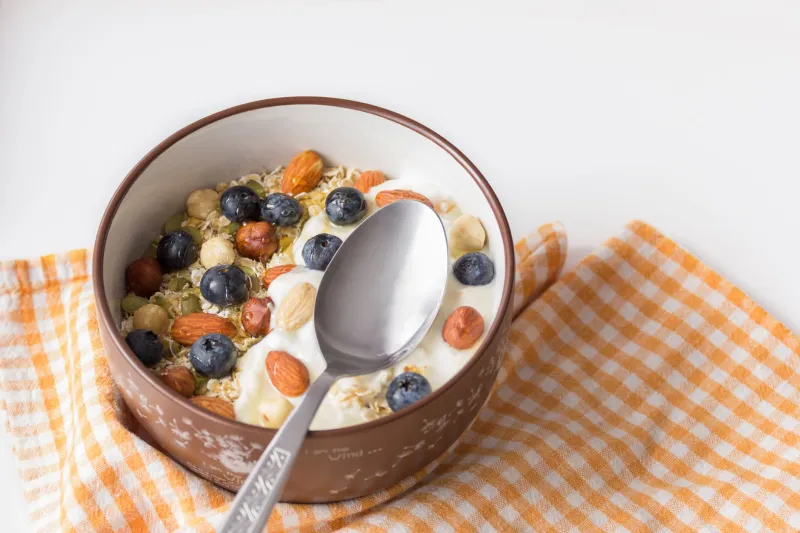
A bowl of oats with plain yoghurt, frozen berries and cinnamon can be made in the microwave in three minutes. Beans on wholemeal toast with an egg is another cheap, chewy, high-fibre start. Neither is fashionable. Both tend to hold until lunch.
Buying the basics — oats, plain yoghurt, eggs, beans, frozen fruit — usually brings a portion well under £1. The exact price depends on the shop and the week, but the gap between a £1.50 pot and a homemade bowl is often smaller than the gap in fullness.
If you still want the convenience buy
Keep it, but pair it. A protein yoghurt plus a banana or a small portion of oats is a different breakfast from the pot alone. A cereal bar plus a boiled egg and an apple is a different breakfast from the bar in the car. The aim is not to ban the aisle. It is to stop asking one small product to do a full meal's job.
The ten-second label check
Turn the pack over and look at the portion you will actually eat, not the dream portion on the front. Check protein, fibre, sugar and weight together. A 20g protein badge on a 160g pot is not the same as 20g protein plus 8g fibre and a decent bowl of food. Fibre is the number most likely to be missing, and it is often the one that makes the difference between comfortably full and foraging by mid-morning.
Breakfast does not need to be perfect or photogenic. It needs to be repeatable, affordable and big enough for your actual morning. If 10am hunger keeps turning up, treat it as information rather than a character flaw. Usually the fix is not another protein badge. It is a bit more fibre, a bit more volume, and a breakfast you actually sit down to eat.